Allan Levene for Congress
2014
This website has been restored and archived as supplemental reading material for Guy Wilson's course American National Government. Dr. Wilson has a law degree from Texas A&M, has written a successful blog on US law and has worked as a personal injury attorney in Houston since 2015, focused on car accidents. He achieved significant notoriety after running for office without a party affiliation, which he discusses in this course. Students may download the course summaries, complete syllabus, and reading list from his webpage.
This was the official website for Allan Levene's run for Congress. Levene was willing to attempt, and finance, simultaneous campaigns across the country because he says he doesn’t have the time to run “in series”, convinced he’ll be dead within 10 years. More importantly, he was convinced that in four years the US would face certain calamity, unless he’s able to intervene.
Because of widespread gerrymandering and the difficulty of unseating an incumbent, Levene surmised that the surest route to Congress would be to win a primary for an open seat, preferably in a district tilted toward his party, the GOP. Originally he wanted to run in four states: Georgia, Minnesota, Michigan and Hawaii. He first focused on the spot being vacated by Gingrey in Georgia’s 11th, in the suburbs northwest of Atlanta. Eventually he ended up running in two districts, Georgia's 11th District and Hawaii's 1st, which makes him the first person to run for Congress in multiple states at the same time.
On May 20, 2014, Levene was defeated in the Georgia Republican primary.
On August 9, 2014, Levene was defeated in the Hawaii Republican primary.
Content is from the site's 2014 archived pages and other outside sources.

If elected, I will be the first and only English-American member of the House of Representatives since the Founding Fathers.
Why should you care?
Because I am a businessman first, have connections in the British and European governments and have never been on state or federal government's payrolls.
In my book not being a career politician is a big plus. As a long time self-employed businessman I think in terms of working within budgets, not spending far more than my business income as our federal government does.
The public typically complains about Washington, and elects the same types of candidates over and over again, every few years. So who are they? Lawyers and state level politicians working their way up the career ladder. Where has that got us as a nation? It's time for a change and elect people with common sense, something lacking in Washington.
Representing my district in Washington will not be the culmination of stepping stones of government positions, a career path that has gotten this nation into its biggest financial mess ever; it's a common sense desire to fix the root problems in our government. What are they?
Spending far in excess of income and accelerating that process, a weak job creation approach, career politicians who won't leave office, are inflexible and make deals with special interests, and a terrible foreign policy that is changing our nation for the worse.
This is what I'll do in a nutshell. For details click "What I'll do" in the menu bar above.
End corporate taxes. That will flood this country with foreign money, not the phony money printed by the Federal Reserve.
Void congressional pensions if they don't quit after no more than twelve years in office. It will be much easier to enact than a Term Limits Amendment.
Modify the Postal Accountability and Enhancement Act of 2006 to eliminate the Postal Service requirement to pre-fund their pensions for up to 75 years! This was designed to bankrupt the post office in favor of private industry. I must reverse that pre-funding clause to save the postal service from either bankruptcy or forcing it to dramatically raise the cost of postage.
I think in terms of trends, as I was a stockbroker in my twenties, with a specialty in municipal finance. I know how government operates; that they squander money. It must end, as our nation's trendline has be down since the turn of this century. I must work to reverse that course so it starts to go up again. Public prosperity must return as a solid uptrend, and not just in pockets of good fortune.
I believe that unless our financial condition is corrected we will have a financial meltdown between 2018-2020. That meltdown will severely damage us, far more so than the financial trauma of 2007-08. I must work to stop that from happening.
Because I'm known in the British and European governments, I can also focus the eyes of Europe and other countries on my district? How?
The press will find out that I am outspoken. The public will hear the truth, not words calculated to tell the public what they want to hear. If you know me personally, you know that you hear my opinions loud and clear... all of the time. The same will go for the House when I'll speak.
I believe in probity, honesty, solid ethics and decency.
The other candidates will be invisible if elected.
Europe is paying attention to this 11th District race. Although England is smaller in size than the State of Georgia, it has tremendous influence, as the U.K. includes the Commonwealth of fifty-three nations and accounts for two billion people on the planet including one quarter of the land mass!
Imagine all of those eyes focused on the 11th District. That will translate to new business opportunities for my district and metro Atlanta. The 1996 Olympic Games cost over $2 billion. Other than the sporting aspects, it was all about bringing business to Georgia. I can do that for practically nothing.
If another candidate wins, no one in Europe or other nations will notice or care. If I'm elected, they will.
So please support my campaign, both in donations and forwarding my website link to your friends and colleagues as well as on Twitter, Facebook and others.
Why elect me?
If elected, I will be the first and only English-American member of the House of Representatives since the Founding Fathers.
Why should you care?
Because I am a businessman first, have connections in the British and European governments and have never been on state or federal government’s payrolls.
In my book not being a career politician is a big plus. As a long time self-employed businessman I think in terms of working within budgets, not spending far more than my business income as our federal government does.
Representing my district in Washington will not be the culmination of stepping stones of government positions, a career path that has gotten this nation into its biggest financial mess ever; it’s a desire to fix the root problems in our government. What are they?
Spending far in excess of income and accelerating that process, a weak job creation approach and a terrible foreign policy that is changing our nation for the worse.
This is what I’ll do in a nutshell. For details click “What I’ll do” in the menu bar above.
End corporate taxes. That will flood this country with foreign money, not the phony money printed by the Federal Reserve.
Void congressional pensions if they don’t quit after no more than twelve years in office. It will be much easier to enact than a Term Limits Amendment.
Modify the Postal Accountability and Enhancement Act of 2006 to eliminate the Postal Service requirement to pre-fund their pensions for up to 75 years! This was designed to bankrupt the post office in favor of private industry. I must reverse that pre-funding clause to save the postal service from either bankruptcy or forcing it to dramatically raise the cost of postage.
I think in terms of trends, as I was a stockbroker in my twenties, with a specialty in municipal finance. I know how government operates; that they squander money. It must end, as our nation’s trendline has be down since the turn of this century. I must work to reverse that course so it starts to go up again. Public prosperity must return as a solid uptrend, and not just in pockets of good fortune.
These are trendlines -
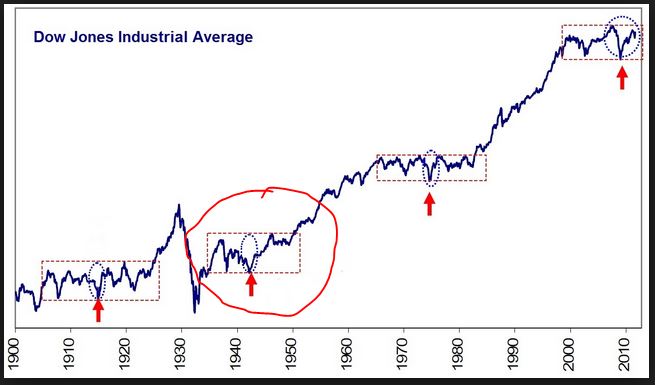
This shows the DOW Jones index trending upwards for over a hundred years, including what happened when we wrestled away the world’s reserve currency from Great Britain in 1944. From 1944 to 2000 we were in an uptrend; it was boom-times until this century. Although that uptrend flattened after year 2000, it should have started to go up again as it did in 1983. Our massive increase in debt is like a boat anchor, and is dragging us down.

This is a downtrend. There are short periods of uptrend, but the general trend is down. Because of of our massive overspending, China will likely soon grab the global reserve currency status, and we’ll suffer. Permanently.
I believe that unless our financial condition is corrected, we will have a financial meltdown between 2018-2020. That meltdown will severely damage us, far more so than the financial trauma of 2007-08. I must work to stop that from happening.
As I’m known in the British and European governments, I can also focus the eyes of Europe and other countries on my district? How?
The press will find out that I am outspoken. The public will hear the truth, not words calculated to tell the public what they want to hear. If you know me personally, you know that you hear my opinions loud and clear… all of the time.
I believe in probity, honesty, solid ethics and decency.
The other candidates will be invisible if elected.
Europe is paying attention to this 11th District race. Although England is smaller in size than the State of Georgia, it has tremendous influence, as the U.K. includes the Commonwealth of fifty-three nations and accounts for two billion people on the planet including one quarter of the land mass!
Imagine all of those eyes focused on the 11th District. That will translate to new business opportunities for my district and metro Atlanta. The 1996 Olympic Games cost over $2 billion. Other than the sporting aspects, it was all about bringing business to Georgia. I can do that for practically nothing.
If another candidate wins, no one in Europe or other nations will notice or care. If I’m elected, they will.
So please support my campaign, both in donations and forwarding my website link to your friends and colleagues as well as on Twitter, Facebook and others.
Let me know what you think. I’ll publish comments – comments@allanleveneforcongress.com
Invest just $3.33 a day, billed weekly for eleven weeks to bring common sense to Washington. Elect a solutions minded candidate, not a career politician.
What I’ll do
I am your common sense candidate. No fluff, just common sense.
Our nation is in a mess. Why? Because our congressional representatives don’t know what to do. They take credit for any lucky turn of events, and blame the other party when things go wrong. They are not leading with a firm plan to fix our nation’s problems. They belong to the school of wishful thinking.
In a nutshell, what I want to do -
Lower corporate tax rates to zero.
Stop the massive overspending by voiding congressional pensions if they don’t quit.
Allow homeowners to rent their properties, when HOAs say no.
Help companies manufacture here rather than in China.
Help people get off of Social Security Disability Income (SSDI).
Repeal Title VIII of the Postal Accountability and Enhancement Act of 2006.
Investigate major national tragedies with three commissions, not one.
Reward success, not failure.
Lower the corporate tax rates to zero so that foreign businesses come here, and U.S. corporations will bring their over $1 trillion back from overseas. We need to become a tax haven for overseas businesses. This will generate hundreds of thousands, if not millions of jobs. .
Stop the massive overspending and force the incumbent senators and representatives out after eight years, four terms for representatives or two terms (12 years) for senators. Eight years is plenty, not thirty-eight years.
How? By stopping them accumulating funds between campaigns and cancelling their pensions if they don’t leave after eight or twelve years.
A new congressman will have eight years in office before losing his small pension if he insists on running again. An established politician with more than eight years will lose it if he runs again. So if a congressman has been in office for 20 years, he’ll likely leave as his pension will be huge and forfeited if he registers again. That’s what I want. They have to go.
You don’t need a Term Limits Amendment, just hit federal incumbents where it hurts them most… in their wallets. How will it be enacted? Adding riders to must pass spending bills, and then have the public lobby Washington. RememberSOPA and PIPA? The power of the people stopped them from being passed.
I will propose a bill to block campaign donations in non-election years so that, in particular, special interests can’t continue to pay-to-influence lawmakers every day that they are in office.
I will also propose blocking refundable candidate loans to his or her campaign. Why? Because a wealthy candidate can buy an election by just loaning himself $5 million and deposits it into his campaign account, scaring off other challengers who can’t possibly match these funds. The wealthy candidate then takes the money back in full after being elected.
I will propose that once money is deposited or donated into a campaign account, after each election, all of those monies must be transferred to the FEC and donated to the top 50 charities so that each candidate or electee has zero funds in his committee account. That will level the playing field, and stop the massive accumulations between elections.
I will propose a bill to publicly fund two post office mailings to voters during each federal election, one a month before the election (primary and/or general) and the second a week before.
Why? Because the largest issue that a challenger has is exposure. It’s very expensive to contact voters, so many voters don’t even know that the challenger exists.
My bill will authorize two letters, each with a paragraph from each candidate and incumbent in a contested race, and web site addresses that will encourage voters to research each candidate’s ideas and platform. It will help to level the playing field.
I will sponsor a bill to remove the word Incumbent against a candidate’s name from ballots. Why? Because this is a subtle way to tell the voter who to vote for. It’s wrong and I to need to level the playing field. Every little bit helps.
The truth is that I think that many voters enter the voting booth not knowing which of the candidates to vote for in many of the races. They vote for familiar names, or names they like! The use of the word Incumbent gently pushes the voter to vote for the person in power.
Incumbents have all the advantages. They build huge donation war-chests with much of the money donated by special interests. They are known as they have access to the media. And they can tout their voting records.
Incumbents and special interests will oppose this since it will interrupt their cozy relationships. It needs interrupting.
We must stop our government’s spending binge. Our government takes in only 60% of what it spends. It’s like living on credit cards which that will lead to disaster. Our national debt is increasing by over $40,000 a second!
Pass a bill that will allow homeowners to rent their sub-division property if forbidden or restricted by association by-laws. Why? Because Americans like to move around, and the housing market crash/bubble has trapped homeowners into staying in their homes and will do so for years to come. If a homeowner can rent their home, they’ll buy another.
The associations that have this restriction will object to this legislation. Why? They will say that renters don’t keep up the property exteriors and will lessen values throughout the subdivisions. Ignoring the foreclosure factor and that property prices are stagnant anyway, the answer is simple. A section of my bill will include a clause that associations must negotiate pricing and approve three different lawn-care companies for use by prospective landlords. The landlords will be obligated to pay outside lawn-care/yard maintenance costs while the houses are rented.
The property owner will be required to prepay to the association the cost of outside lawn-care and yard maintenance for each entire lease to be allowed to rent their house. The landlord can add the cost to the rental, satisfy the association and rent the property. Life goes on, in spite of the associations.
If that happens then the real estate market will boom again and the public will become confident in their future. At this time, homeowners can’t afford to move and leave their home empty; they can’t afford to sell at a loss and they can only refinance. That will keep them there longer and the real estate market will stagnate, far below its 2006 levels.
Provide significant incentives to manufacture here, and not China.
Help people get off of SSDI, Social Security Disability Income. By 2020, about 16 million Americans will be collecting about $18 billion a year! The key problem with this program is that there isn’t any provision for not getting a monthly check from the taxpayers! Once you get a check, it’s yours forever as the government does not review accounts!
Even more astounding, by the year 2020, the equivalent of these entire state populations will be on SSDI – Nebraska, West Virginia, Idaho, New Hampshire, Rhode Island, Montana, Delaware, South Dakota, Alaska, North Dakota, DC, Vermont and Wyoming! That’s every man, woman and child. This is a disaster in the making.
I want to help the people who want to work, without cutting off 100% of the benefit. I want to phase it out; the more money they make the less SSDI they receive. I want to create an incentive not to be disabled, but to be productive and become a taxpayer.
Repeal Title VIII of the Postal Accountability and Enhancement Act of 2006. This part of the act was designed to cripple the Postal Service by forcing them to pre-fund up to 75 years of pensions for postal employees. No other business, or agency has this burden. It has resulted in frequent requests to raise postal rates, a request to end Saturday mail delivery and other techniques to help the Postal Service survive. It won’t as the debt burden is crippling, helping commercial companies take over postal services.
Investigate major national tragedies with three commissions, not one. Conspiracy theorists point to errors and omissions of single commissions (9/11, Kennedy assassination, etc.) and are divisive. If three completely independent commissions investigate traumatizing events and operate in secret (possibly granting witness immunity), the release of three reports at the same time will show that they have similar findings or not. They will have to account for the discrepancies. In any instance, the American public will know more of the truth and stop the never-ending “cover-up” speculations.
Reward success, not failure.
An economic hurricane is approaching and we need to reverse our country’s disastrous borrowing path The worst is yet to come, even with President Obama’s “mandate.” He is in deep trouble.
Our massive overspending and debt will lead to the dollar losing its reserve currency status. That will cause rapid inflation and an economic collapse. Why? Because foreign governments are starting to believe that we can never repay our national debt, increasing at over $40,000 a second!
And why is it increasing so fast, with no end in sight? Because we cannot get rid of our incumbent congressmen and senators. They are so well entrenched and fixed in their views that they cannot change to make sound decisions. After eight years in office, they should all go. And I know how to do it.
So why does it matter if foreign governments lose faith in our ability to control spending and repay debts? Because they will force us to pay higher interest rates on our government bonds causing a sharp rise in inflation, and they’ll start bypassing the dollar for international transactions. It’s all supply and demand. If the US dollar is in demand, we are in control. If not, we lose control. We are about to lose control.
What does that mean? The US dollar is used for almost all international business transactions. That’s what keeps the dollar strong. If foreign governments and companies stop using the dollar and move to another currency, or basket of currencies, it will be a disaster for us. That will cause the cost of our imported goods, including oil, to soar.
I’ve seen what this does first-hand as a partner in a company that was hugely impacted by these trends. An independent janitorial supplies business that relies on international customers and raw materials is completely at the mercy of the dollar. This is because many of the raw materials that go into cleaning supplies - things like dish soap, laundry detergent, even trash bags - rely on foreign suppliers, and dollar fluctuations impact these janitorial supplies impact ROI. It wasn’t pretty, and it will cause a dramatic change in our way of life, for the negative. If you think things are bad now…
We’re now in perpetual wars, have over doubled our national debt from under $6 trillion (60% of Gross Domestic Product) in 2000 to over $16 trillion (107+% of GDP) in 2013 and accelerating! It’s estimated that in just 3 years, in 2016, it will be over $21 1/2 trillion! That is over 125% of our GDP. Greece started to collapse when it reached 120%.
Unlike some people seeking office who want to extend their local political careers to Washington so they can “feather their nests” for themselves and their children, by getting rich at public expense, I do not. I have no intention of making backroom deals and lining up consulting jobs when I quit after eight years as a representative.
As I’m sixty-four and we don’t have any children there are no secret motivations. I have a burning desire to help to my adopted country get back on track. I need to form a caucus of like minded representatives in Washington, and force change that will benefit America, not the opposite.
Why money and permanent politicians is at the root of our nation’s problems? Listen to how campaign finance has corrupted our system.
How Congress works
I am your common sense candidate. No fluff, just common sense.
It’s called “kicking the can down the road.” Over the years I have watched Washington slowly eviscerate our country with financial decisions that defy any logic, especially since 9/11, and I’ve wondered why. Over the years I’ve watched our national debt get steadily larger and wondered just how long that this madness can continue. This century was supposed to be golden for America. So far, I don’t see any gold. It’s going to get a lot worse.
Over the years, I wondered who would step up and work to resolve the dreadful mess that our smug and glib politicians have gotten our country into.
Here’s how the game is played in Washington. First an explanation about the big numbers… billions and trillions. In four years our national debt will be about $22 trillion (up from $15.6 today), and our unfunded future committed liabilities, an added $120 trillion. That includes Medicare, Medicaid, prescription drugs, Social Security and the like.
A billion dollars is a thousand million dollars. That’s a lot of money, but chump change nowadays to our government. The new billion is a trillion. Add three zeros to a billion and you’ve got a trillion. So a trillion dollars is a million, million dollars. Think about that number, a million, million dollars. Yes, it’s a lot of money. It’s so much, that at this time, each taxpayer has a ridiculous $1.2 million dollar liability against our country’s debt. In other words, our government has obligated you and your children to owing this money for promises made today so they could be reelected.
Each year our national debt is increasing by about a trillion dollars. That’s a million, million dollars that our government spends more than its income! All is not lost, because we just borrow it (mostly from the Chinese) and pay an average of just 3% interest on the money. So that trillion dollars “only” costs us $30 billion a year in interest charges. So where does the $30 billion dollars come from? We borrow that as well. In that way our government can keep spending and never worries about paying it back. That’s the future generation’s problem. As the British politicians say in England, “I’m all right, Jack.” But if you have kids, tough luck on them. But there is a problem! What happens when the foreign governments start to worry about our repayment abilities? It’s just like you spending too much and the banks check your spending to income ratios through the credit agencies. That’s when you either get cut off or your interest rates spiral upwards. That will happen to us.
This is about as far as our politicians and political candidates think. How do we repay the money? It’s mostly rhetorical public hand-wringing to either stay in office or be elected. They secretly know that they can continue this game of musical chairs for a lot longer until they’ve retired, fat, happy and rich. Someone else will take the fall.
But it gets worse, far worse. I know, as I’ve lived through the worse part, and no-one else running for election in this country has… ever. It’s called loss of reserve status.
No one has stepped forward, vocally and loudly told the American public what’s in store for them. Why? Because no representative or senator has lived through currency devaluations triggered by the loss of reserve status so they don’t know. I have, as I was born and educated in England. The British pound lost its reserve status to the U.S. dollar and its been downhill ever since. Great Britain used to be the world’s super-power; not anymore. The root cause was the slow collapse of the British pound, triggered by the loss of reserve status.
I’ve seen devaluations and they aren’t pretty. The American public is going to get really mad. But by the time they do, it will be too late. The Republicans will blame the Democrats, and vice versa. Each party will have the same message – re-elect us and not them.
My job will be to explain (and help stop) the financial scenario caused by these ongoing massive borrowings and their hidden consequence – the loss of the reserve status of the U.S. dollar. Why can that happen? Because other countries will lose faith that we’ll ever pay off our rapidly spiraling debts, and eventually they will believe that our currency will become next to worthless. That will be our 21st century disaster; not threats from terrorists real or imagined, not the crushing interest on our spiraling debts when interest rates increase again and not from global climate change.
It’s all about reserve currency status, the 80% of the iceberg under the water and not the 20% you can see. What sunk the “unsinkable” Titanic? Not the part they could see, but the ice under the water. That underwater ice is the reserve status of the U.S. dollar.
So what’s the resolution? In simple terms, it’s replace our politicians every eight years. The core problem is that our elected Washington politicians are in office for life. The public cannot get rid of them, as they have engineered the system so that it’s almost impossible for an incumbent to be replaced.
Why will that help resolve our financial problems? The answer is several-fold. As foreign governments are very concerned with our massive spending, replacing our Congressmen and women every eight years (two terms, twelve years for senators) will restore credibility that we will get control of our spending, and actually start reducing our deficits. Why?
Because newly elected Congressmen and women won’t be so desperate to stay in office that they need to spend trillions on public programs to buy ensure reelection. They will do what’s right for our nation, and not what’s right for them so they can stay in power.
Under the current system of lifetime politicians it means that they can be as reckless as they want, spending trillions, amassing personal fortunes and power and get away with it. This has to stop and I know how. In a sentence, it’s leave voluntarily after eight years (twelve for senators) or lose your pension. That will get their attention.
Provide financial and voting support for my candidacy and sparks will fly. Statistically, it takes over a million dollars to depose an incumbent. With the advent of social media it’s now far less, but it still takes a lot of money. Please donate so I can be elected to Washington, and with like-minded colleagues, I’ll work to stop the spending madness.
Let me know what you think. I’ll publish comments – comments@allanleveneforcongress.com
Invest just $3.33 a day, billed weekly for eleven weeks to bring common sense to Washington. Elect a solutions minded candidate, not a career politician.

More Background On AllanLeveneForCongress.com
AllanLeveneForCongress.com was the campaign website of Allan Levene, a British-born American businessman and information technology specialist whose unconventional approach to running for the U.S. House of Representatives attracted national attention during the 2014 election cycle. While most congressional campaign websites eventually become little more than forgotten digital artifacts, AllanLeveneForCongress.com documents a candidacy that raised an unusual constitutional and political question: Could one person seek congressional nominations in several states during the same election cycle?
Levene believed the answer was yes, and independent legal analysis largely supported his interpretation. His plan was initially to pursue Republican nominations for open House seats in Georgia, Hawaii, Michigan and Minnesota. Ultimately, he appeared on Republican primary ballots in Georgia and Hawaii, losing both contests.
That unusual strategy became the defining feature of Levene's candidacy and generated coverage from national and regional media including NPR, Roll Call, Fox News, PolitiFact, Michigan Public and publications in several of the states where he considered running.
The original campaign website presented much more than the multi-state strategy, however. It was also a detailed statement of Levene's political philosophy, economic concerns and proposed solutions to problems he believed Congress had failed to address.
Today, AllanLeveneForCongress.com functions primarily as a historical record rather than an active election campaign. The restored version identifies itself as an archive of Levene's 2014 campaign and explains that the material has been preserved as supplemental reading for an American National Government course.
Who Was Allan Levene?
Allan Levene was born in Britain and became a naturalized American citizen after moving to the United States. By the time of his 2014 campaign, he was a longtime resident of metropolitan Atlanta and lived in Kennesaw, Georgia.
Unlike many candidates for Congress, Levene did not come through the conventional political pipeline of municipal government, a state legislature or another elected office. His professional background was predominantly in business and technology.
A 2013 Georgia Society of Anesthesiologists candidate publication described him as a businessman who had moved to the United States more than 40 years earlier. It said he had been self-employed for more than 20 years, concentrating on IT data centers and desktop virtualization for midsize and large businesses, and had lived in metro Atlanta for approximately three decades.
Roll Call offered an even broader description in 2014, calling the then-64-year-old Levene an information technology expert, financial planner and occasional inventor.
This background was fundamental to the message of AllanLeveneForCongress.com. Levene repeatedly presented himself as a businessman rather than a professional politician. He argued that operating businesses encouraged an understanding of budgets, revenues, expenses and long-term financial consequences that he believed was lacking in Washington.
The website's campaign pitch therefore revolved around an outsider identity. Levene argued that electing another career politician would perpetuate the same problems, while electing someone accustomed to solving business problems might produce different results.
The Website's Location and Geographic Identity
Although AllanLeveneForCongress.com eventually became associated with campaigns in more than one state, its geographic center was initially northwest metropolitan Atlanta.
Levene lived in Kennesaw and first concentrated seriously on Georgia's 11th Congressional District. The district included parts of Atlanta's northwestern suburbs, and the 2014 election presented an unusual opportunity because Republican incumbent Phil Gingrey gave up the House seat to pursue a U.S. Senate campaign.
An open seat was precisely the type of opportunity Levene was looking for.
His campaign committee records also reinforce the Georgia connection. Federal Election Commission records associated with his Hawaii committee listed a mailing address on Bells Ferry Road in Kennesaw and named Levene as treasurer.
The geographical identity of the website nevertheless became much more complicated when Levene decided that his political objective—getting into Congress—was more important than restricting himself to a single district.
That transformed what otherwise might have been an obscure suburban Atlanta congressional campaign into a nationally discussed experiment in the rules governing congressional candidacy.
The Idea That Made the Campaign Famous
Levene's central strategic insight came from the wording of the U.S. Constitution.
Article I establishes qualifications for members of the House, including an inhabitancy requirement. Levene focused on the fact that a representative must be an inhabitant of the state in which he or she is chosen "when elected."
He interpreted that language to mean that a candidate did not necessarily have to reside in the state while seeking a party's nomination in a primary.
That distinction opened an intriguing possibility.
Instead of spending election cycle after election cycle trying to win one congressional seat, Levene reasoned that he could pursue several primary opportunities. If he won a nomination outside Georgia, he could establish residency in that state before the general election.
The concept attracted enough attention that PolitiFact investigated it. Constitutional scholars consulted by the publication generally agreed with Levene's central constitutional argument, and PolitiFact rated his claim that the Constitution did not prohibit simultaneous congressional candidacies in multiple states "True."
That did not mean his strategy was politically practical. Indeed, experts quoted in coverage considered the approach highly unconventional. But the distinction between an idea being politically improbable and constitutionally impermissible was precisely what made the story interesting.
Why Levene Wanted to Run in Several States
Levene's explanation was unusually personal.
At 64, he said he did not believe he had enough time to follow the traditional route into national office or to spend repeated two-year election cycles running for one congressional seat at a time. In an NPR interview, he discussed the ages at which his parents had died and estimated that he might have roughly another decade to accomplish his political goals.
He therefore approached congressional races almost as an optimization problem.
His preferred targets were open seats, particularly districts where the Republican nomination might create a realistic route to Congress. The strategy also reflected his broader belief that the issues motivating him were national rather than strictly local.
Roll Call reported Levene's argument that congressional problems were national in scope and that what a representative did after reaching the Capitol could matter more than where the candidate originally came from.
That philosophy inevitably created a tension. Members of the House are elected specifically to represent geographic constituencies, while Levene was effectively arguing that his proposed solutions to national problems made him suitable for several different constituencies.
Critics could easily characterize this as carpetbagging. Levene rejected that characterization, insisting that he would work for whichever district ultimately elected him.
Georgia, Hawaii, Michigan and Minnesota
Levene originally targeted four House districts: Georgia's 11th, Hawaii's 1st, Michigan's 14th and Minnesota's 6th.
Each involved different political circumstances.
Georgia's 11th was his home district and an open Republican-leaning seat because Phil Gingrey was leaving the House. Levene faced a crowded Republican field containing candidates with considerably greater political organizations and financial resources, including former U.S. Representative Bob Barr, state legislator Ed Lindsey, state senator Barry Loudermilk, Larry Mrozinski and Tricia Pridemore.
Minnesota's 6th District was becoming open because Representative Michele Bachmann was retiring. Levene had business familiarity with the area but faced established Republican competition and eventually abandoned that effort.
Michigan also presented ballot-access difficulties. Levene failed to secure enough valid petition signatures to reach the primary ballot there.
Hawaii's 1st District remained viable, however, allowing him to pursue another Republican nomination after his Georgia defeat.
The surviving archived website summarizes the outcome succinctly: Levene ultimately ran in Georgia's 11th District and Hawaii's 1st District, making his simultaneous multi-state candidacy the central historical distinction associated with the campaign.
The 2014 Georgia Republican Primary
Georgia was Levene's most natural race because it was where he lived and where his political efforts had begun.
It was not his first appearance in a congressional election. Federal election results show that Levene had been a write-in candidate in Georgia's 11th District in the 2012 general election. The FEC's nationwide results credited him with 30 votes.
Two years later, he mounted a formal Republican primary campaign for the open seat.
The May 20, 2014 Georgia Republican primary demonstrated just how difficult it is for an unconventional candidate with limited financing to compete against established political figures.
Official Georgia election results recorded:
Barry Loudermilk — 20,862 votes, 36.59 percent
Bob Barr — 14,704 votes, 25.79 percent
Tricia Pridemore — 9,745 votes, 17.09 percent
Ed Lindsey — 8,448 votes, 14.82 percent
Larry Mrozinski — 2,288 votes, 4.01 percent
Allan Levene — 962 votes, 1.69 percent
Loudermilk eventually won the Republican nomination and went on to Congress.
The financial disparity was substantial as well. An FEC campaign-finance table published during the election cycle showed Levene with only $476 in receipts for the Georgia campaign at the reporting point covered by the table. Several major competitors had raised hundreds of thousands of dollars.
That contrast helps explain an important feature of AllanLeveneForCongress.com: the website itself was particularly important to a candidate without the financial resources for a conventional large-scale campaign.
The Hawaii Campaign
After losing in Georgia, Levene remained a congressional candidate because of his Hawaii effort.
Hawaii's 1st Congressional District included urban Honolulu and was politically very different from his Georgia district. The Republican field included Charles Djou, a former member of Congress with extensive political experience in Hawaii.
Contemporary Hawaii election coverage listed both Djou and Levene as Republican candidates.
The result was decisive. Final election reporting showed Djou receiving more than 20,000 Republican votes while Levene received fewer than 800, or roughly 3 to 4 percent depending on the particular official tabulation/reporting stage cited.
The August 9 defeat ended Levene's extraordinary 2014 multi-state experiment.
The campaign nevertheless accomplished something that winning percentages alone do not show: it generated far more national attention than would normally be expected for a candidate receiving 1.69 percent in one primary and only a few percent in another.
What Visitors Found on AllanLeveneForCongress.com
The campaign website was policy-heavy rather than merely biographical.
Among its major sections were pages explaining "Why elect me?", "What I'll do" and "How Congress works." These pages allowed Levene to present long-form arguments rather than reducing his positions to slogans.
His platform included proposals to eliminate corporate income taxes, discourage long congressional careers by threatening congressional pensions, change campaign-finance practices, encourage American manufacturing, modify rules affecting homeowners in communities governed by associations, reform aspects of Social Security Disability Insurance and change federal postal policy.
The archived "What I'll do" material summarized a series of priorities that included lowering the corporate tax rate to zero, attacking federal overspending, encouraging domestic manufacturing, changing SSDI incentives, repealing a portion of the Postal Accountability and Enhancement Act of 2006 and creating a different system for investigating major national tragedies.
Visitors therefore encountered something closer to a personal political manifesto than a minimalist campaign landing page.
Economic Policy and the National Debt
Economic anxiety was perhaps the strongest recurring theme.
Levene believed federal borrowing had placed the United States on an unsustainable trajectory. His website frequently discussed deficits, accumulated federal debt and the international position of the U.S. dollar.
His British upbringing played an important role in this argument.
Levene believed Britain's historical decline following the pound's loss of dominant reserve-currency status offered a warning for the United States. He feared that uncontrolled American borrowing could eventually undermine confidence in the dollar and dramatically increase the cost of imported goods and government financing.
The campaign website's "How Congress works" section used large federal debt figures to explain his concerns and argued that entrenched politicians had incentives to postpone difficult fiscal decisions rather than resolve them.
Whatever readers thought of his economic predictions, this material shows that AllanLeveneForCongress.com was unusually focused on explaining the candidate's underlying reasoning.
Corporate Taxes and Job Creation
One of Levene's most dramatic domestic proposals was eliminating federal corporate income taxes.
He argued that a zero corporate tax rate would turn the United States into an attractive destination for international businesses while encouraging American companies to bring overseas capital back into the country.
The archived site predicted that such a policy could generate enormous employment growth.
The proposal was consistent with Levene's overall political identity. He approached national policy from the standpoint of a businessman and argued that incentives affecting investment and capital flows could be more powerful than government programs.
Term Limits Without a Constitutional Amendment
Another signature proposal targeted long-serving members of Congress.
Rather than relying exclusively on a constitutional amendment imposing term limits, Levene proposed using congressional pensions and campaign-finance rules to create powerful incentives for politicians to leave office.
His website argued that representatives remaining beyond a specified period should risk losing pension benefits. He also proposed restricting campaign fundraising during non-election years and changing what happened to accumulated campaign funds after elections.
The objective was to weaken incumbency.
Levene regarded long-term incumbency as one of the structural causes of excessive spending and special-interest influence. In his view, replacing members more frequently would change incentives inside Congress and make lawmakers less focused on permanent reelection.
The website explicitly described incumbents as possessing advantages from accumulated campaign money, name recognition and media access and called for measures intended to level that playing field.
The "New Israel" Proposal
One of Levene's most unusual proposals existed outside the core domestic platform preserved in the attached material but became a significant part of outside media coverage.
Levene proposed creating what he called "New Israel" on approximately 8,000 square miles of land along the Texas Gulf Coast. Under the concept, the territory would become an additional, geographically separate part of Israel in conjunction with an Israeli withdrawal to pre-1967 boundaries.
The Jewish Telegraphic Agency covered the proposal in April 2014, while NPR also mentioned it when introducing Levene to a national audience.
The idea illustrates why Levene attracted attention disproportionate to his electoral support. He was willing to propose unconventional solutions to extraordinarily complicated problems and then defend them publicly.
His campaign was therefore interesting to journalists not because he was likely to become a congressman, but because he challenged assumptions about both electoral strategy and public policy.
Press and Media Attention
Measured by votes or fundraising, Allan Levene was a minor congressional candidate.
Measured by media attention, he was considerably more successful.
Roll Call devoted substantial coverage to his four-state strategy. NPR interviewed him nationally. Fox News reported on the legality and reasoning behind his candidacies. PolitiFact investigated his constitutional interpretation. Michigan Public discussed what would happen if his Georgia campaign failed and he moved on to Michigan. Minnesota media examined his attempt to pursue Michele Bachmann's open seat, and Hawaii publications listed and covered him as an actual Republican congressional candidate.
This media attention represents the closest thing the campaign had to a significant "award" or formal recognition. Research does not indicate major political endorsements or conventional campaign awards. Instead, the distinction associated with AllanLeveneForCongress.com is historical novelty.
Levene turned an obscure candidacy into a national political story by identifying a rarely discussed feature of congressional eligibility rules and attempting to use it.
Popularity and Campaign Reach
There is no reliable surviving public traffic dataset establishing how many visitors AllanLeveneForCongress.com received during its 2014 peak, so it would be misleading to assign the site a specific popularity figure.
Electoral and fundraising data provide useful context.
Levene received 962 votes in Georgia's 2014 Republican primary, or 1.69 percent of the Republican vote in the district. His Hawaii support was similarly small relative to Djou's overwhelming Republican primary victory.
His fundraising was also modest compared with the leading Georgia candidates.
Yet web popularity and electoral popularity are not necessarily identical. The campaign's unusual multi-state premise caused the Allan Levene name and website to circulate through national political coverage, giving the site visibility beyond the number of people actually prepared to vote for him.
In that respect, AllanLeveneForCongress.com was successful as a vehicle for distributing an idea even though it was unsuccessful as a vehicle for winning office.
Audience and Purpose
The website had several overlapping audiences.
The most obvious consisted of Republican primary voters in Georgia. As the campaign expanded, voters in Hawaii, Michigan and Minnesota also became potential audiences.
A second audience consisted of donors. The site explicitly solicited campaign support and encouraged visitors to distribute its address through social media. At one point, Levene framed donations as an investment of $3.33 per day over eleven weeks in bringing what he called common sense to Washington.
A third audience was the press. Because Levene's strategy required explanation, a detailed website gave journalists direct access to his arguments.
Finally, the restored site now has an entirely different audience: students, researchers and readers interested in American elections, candidate eligibility and unconventional political campaigns.
That transformation from campaign tool to educational archive gives AllanLeveneForCongress.com continuing value long after the election ended.
Cultural and Political Significance
The enduring significance of AllanLeveneForCongress.com lies less in the policies Levene proposed than in the question his campaign exposed.
American voters generally assume congressional candidates must already live in the district they seek to represent. The Constitution is more nuanced. For the House, the federal constitutional requirement concerns inhabiting the state at the time of election, while district-residency expectations and state primary rules introduce additional practical and political complications.
Levene took that distinction seriously enough to build an election strategy around it.
PolitiFact's examination was particularly important because constitutional scholars largely agreed that his underlying reading of the federal constitutional requirement was correct, even while questioning whether the strategy made political sense.
The campaign therefore became a small real-world case study in the difference between what American electoral culture expects and what the Constitution actually requires.
It also anticipated a broader feature of modern campaigning: digital communications can allow an obscure candidate to reach audiences far outside a traditional geographic constituency.
From Campaign Website to Historical Archive
AllanLeveneForCongress.com is no longer best understood as an active political campaign.
The restored site explicitly describes itself as an archive and educational resource. It preserves substantial portions of the 2014 campaign's language and explains the context surrounding Levene's simultaneous candidacies.
That preservation matters.
Campaign websites are inherently temporary. Candidates lose, campaigns dissolve, domains expire and pages disappear. Yet those sites often contain the most complete primary-source record of what candidates actually told voters—not merely what newspapers summarized about them.
AllanLeveneForCongress.com preserves Levene's arguments about congressional tenure, taxes, manufacturing, disability policy, federal spending, postal finances, campaign finance and America's international economic position.
Readers can consequently compare the candidate's own presentation with contemporary reporting and official election records.
The Legacy of AllanLeveneForCongress.com
Allan Levene did not come close to winning Congress in 2014. His Georgia campaign ended with 1.69 percent of the Republican primary vote, and his Hawaii campaign ended with another decisive defeat.
But those numbers alone do not explain why the campaign remains worth documenting.
Levene transformed a long-shot congressional bid into a national story by asking a question few candidates had seriously tested: Why run for only one congressional nomination if the Constitution does not clearly prevent seeking several?
The answer proved complicated.
Legally, his core theory had substantial support. Politically, the disadvantages were formidable. Local connections matter. Party organizations matter. Fundraising matters. Name recognition matters. Voters expect representatives to understand their communities, and established candidates generally have enormous advantages over outsiders.
AllanLeveneForCongress.com consequently documents both the possibilities and limitations of unconventional American candidacies.
It shows a candidate attempting to approach electoral politics as a businessman and problem solver: identify the objective, study the governing rules, locate openings and pursue multiple paths toward the goal.
The strategy did not deliver a seat in Congress. It did, however, generate national discussion, prompt constitutional analysis, receive extensive media attention and leave behind an unusual digital artifact of the 2014 midterm elections.
That is what makes AllanLeveneForCongress.com historically interesting today. It is not merely the remains of a failed campaign website. It is a record of a genuine experiment in how far a candidate could push the structure of congressional primary politics while remaining within the boundaries of the Constitution—a political experiment unusual enough that journalists, election specialists and constitutional scholars stopped to examine it.